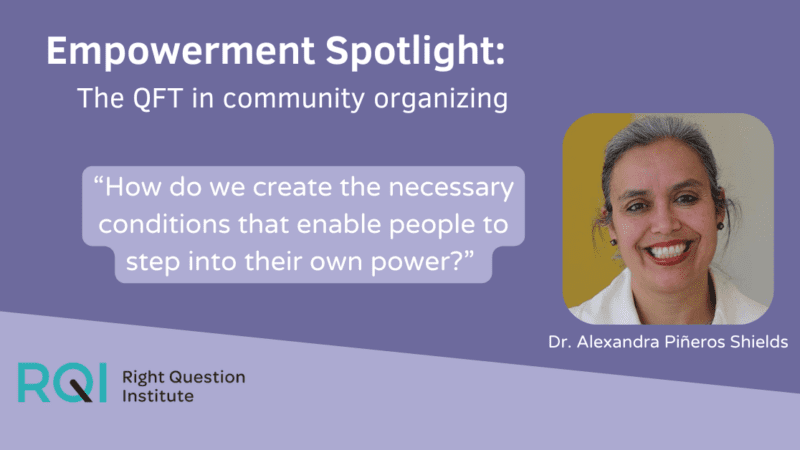
Dr. Alexandra Piñeros Shields has over thirty years of experience bringing communities together and sharing the power of collective action with others. After early work as a paralegal and adult educator, she earned her PhD in social policy from Brandeis University and spent nearly a decade as the executive director of a community organization. She is now the director of the Master of Public Policy program at Brandeis University’s Heller School, where she also serves as an associate professor.
Dr. Piñeros Shields first encountered the Right Question Institute over twenty years ago at an adult education conference and connected with RQI’s founders, Dan Rothstein and Luz Santana. She took and adapted what she learned from that session, using RQI’s Question Formulation Technique [QFT] in adult education classrooms, community organizing, and now with her students at Brandeis.
In 2021, Dr. Piñeros Shields wrote an article titled, “Midwife for Power: Towards a Mujerista/Womanist Model of Community Organizing.” The article presents her theory behind a women-led model for community organizing, and it illustrates this model through a case study — about a successful police accountability campaign — that incorporates the QFT. She proposes that “the ‘Midwife for Power’ model offers an answer to the central question in community organizing: How do we create the necessary conditions that enable people to step into their own power?” She concludes with some essential elements of the model, including “an unwavering commitment to the idea that people are liberated only through their own agency … [and] engaging in collective critical inquiry as a way to fully activate people’s agency and power.”
We interviewed Dr. Piñeros Shields to learn about how she applied the QFT in her work as a community organizer and educator. Our conversation has been condensed and edited for clarity.
Q: What initially drew you to use RQI’s methods?
I was an adult educator in southern New Hampshire at the Adult Learning Center in Nashua. I ran a [family literacy] program called Even Start. I was hired to teach parenting. I quickly found that the parents, who were mostly women receiving TANF (Temporary Assistance for Needy Families), and also immigrant women, didn’t need parenting classes any more than anyone else. So I changed the program and began teaching political and economic literacy. I was making it up as I went along. I had studied [Paulo] Freire, but I was kind of winging it and using my imagination.
I went to a workshop on the QFT and immediately felt, in my skin and in my bones, that it was a powerful experience. When I facilitated the QFT for the first time in the classroom, the potential became very clear. There is power that is shared in a room when you’re using the QFT. It was an environment where there is a horizontal structure in which everyone can participate. It felt very participatory, decentralized.
I tell my students [at the Heller School] that the QFT is the most important thing I’ve learned. My students think I’m kidding. I’m not.
Q: What was your experience using the QFT for the first time?
I went back to the classroom in Nashua and I said to the women in the class, we’re going to learn a new technique. I asked them to choose a problem that was on their mind. Almost without hesitation, the women picked the fact that they were very often investigated for child abuse by the New Hampshire Department of Children, Youth, and Families. They believed that they were investigated more often than other parents. So we developed a Question Focus and they generated lots of great questions. At the end of the class, I said, this is great, these are such great questions, next week we’ll try it again. And they all looked at me like I had seven heads. They’re like, Alexandra, we want our questions answered. For me, it was an academic exercise, but for them this was real. This was what they were living.
The first thing we did was invite the agency district director to a meeting. The women led the meeting, and asked the questions. It was what community organizers call a research meeting. When we debriefed the following week, they wanted to know more about their rights. So we hired a lawyer. The lawyer was not used to spending an hour just answering questions. There was a little bit of tension in the beginning because the lawyer wanted to give a lecture. I had to say, we hired you to answer questions. At the end, the parents did get a lot of information.
One of the things we learned was that New Hampshire was the only state in New England that didn’t have printed material that was widely disseminated around parental rights in child abuse investigations. Given the inquiry we were engaged in, the child protective agency invited the women of the program to help them develop a brochure for public dissemination for the state of New Hampshire. Once a month we would drive up to Concord. I would rent a van and we would drive up and the women would have conversations with the state lawyers. Over the course of a few months, the women edited the responses the lawyers had written to the many of the questions the women had originally posed. They were concerned that no one would understand the legal language so they kept working until they were confident that every parent in New Hampshire reading the brochure would understand their legal rights during investigations of child abuse.
So that, to me, is organizing. That was the first time I used the QFT. It was formative in my early career because I witnessed how mothers who were in GED, Adult Basic Education, or ESOL classes transformed their sense of powerlessness into social action that benefited parents like themselves across the whole state.
Q: Later, you became a community organizer in a more traditional sense, and were the executive director of a community organization.
What are some principles that guided you as a community organizer?
Before teaching in Nashua, I was working at a Central American refugee center during the war in El Salvador. They had a community organizing department, and while I was a paralegal, I saw our clients exercising their power and organizing their own neighborhoods and apartment buildings, and being out on the streets and going to Congress and the Salvadoran Embassy. I saw then that legal remedies often fall short. So it became clear to me that the power of the people, the power to change policy and to change their conditions was something I needed to work on if I wanted to advance social justice.
Later, as the executive director of the community organization, I often said that the goal should be to close our organization because that would mean that everybody in the county knew how to organize. We can’t end social injustice. It’s going to always be there. But we want to ensure that every time there’s a social injustice that communities, in particular oppressed communities, know how to organize and defend themselves. Then we will have done our job. To me, the real goal is for people, through collective action, to transform the way that they perceive their power to change the world around them.
There are five principles I learned over time, upon reflection, and with influence from others around me — some influenced by using the QFT — and some of these ideas I learned from Luz and Dan. And I’m a person of faith, so some of it is spiritual.
The five principles are:
- Every person has inherent dignity.
- Every human being possesses innate rationality and can think for themselves.
- A commitment to radical democracy and radical democratic processes.
- Never do for others what they can do for themselves.
- True liberation rests on mutuality and reciprocity.
Q: In your article, you detail how you used the QFT within a larger police accountability campaign.
How did the QFT align with the principles behind your approach to community organizing?
The type of organizing that I do, the type of organizing that a lot of Latino organizers do, is trying to create the space for people, who are often really marginalized, to interrogate their reality.
I have all my students read The Miner’s Canary: Enlisting Race, Resisting Power, Transforming Democracy by Lani Guinier and Gerald Torres. In chapter one, these two law professors talk about magical realism. The argument they’re making is that we need to create the conditions that pull reality from under us and dislodge what we normally understand so that radically new ideas can come forth. I think that the QFT is a tool that does that. The fact that you can ask questions and there’s no judgment allows you to think outside the box and not censor yourself. Because the QFT is a collective process, thinking in questions creates the conditions for people’s imagination to be unleashed.
I think that what I have found so powerful and so valuable with the QFT is that it is a technique that centers participants. As a facilitator, I am peripheral to it, and in that way, it allows people to use their innate rationality. It’s democratic because I’m peripheral; the QFT decenters my power. In doing so, it allows people to think and act for themselves. It allows them to actually interrogate, plan and execute. This technique allows me to move the principles I mentioned forward in a very elegant way.
I don’t like the word empowerment. All these people had power. The fact that they weren’t using their power was because of structurally oppressive systems. The QFT is a tool that creates a space where people can step into their power.
Q: How can organizers bridge the gap between folks in their communities showing concern about an issue, to them taking action and using their own voice in decision making?
I think that there are two things. First, people need to be in a relationship with each other. This gives people the opportunity to be witness to other people from similar backgrounds that have been able to solve some particular issue. That’s one piece of it.
I think having people in the group who can attest to or be transmitters of history, even if it’s recent history, of previous actions that have occurred is important. I have focused on immigrant organizing and deportation defense. It is vital for people to be able to say “we stopped Rosa from being deported.” Sharing these stories is evidence that a community has power. Not that we might, but we will be able to do it again. This community got something done. I think that moves people, especially if it comes from someone who they’re in a relationship with and it’s someone who’s similarly placed to them, who has a similar background.
The second piece is definitely the tools. People need the tools to understand structural injustice and to expose their underlying assumptions. People can learn to dissect a problem and a set of strategies and tools to be able to act. Here is where the QFT is indispensable. In my experience, it is the single most important tool I know of.
Q: In your article, you wrote, “Often people do not believe they will be capable of their role in a campaign. They may not believe they can create strategy or actually make a difference. They have been told in many ways that they are not capable or intelligent. Their dignity has been denied them so many times they cannot see their own power.”
We have had experiences with people who have told us, “I don’t know if the people I work with are capable of this kind of thinking.” What would you say to the people who believe this?
My initial reaction to your question is to hold a mirror up to the people who think this way, because really, it’s not about the communities these people work with but rather it’s about them and what they believe. I would ask them what makes the people they work with different than other similarly placed individuals who have accomplished social change, whether big or small.
If you don’t believe that people can think and act for themselves, you can never do real power sharing. So you have to interrogate yourselves about what you actually believe. And it’s striking when there is a person in a professional capacity who does believe that people can think and act for themselves. Most people have rarely been in a situation where they are treated as though they could think and act for themselves.
–
Read more about how one community group used the QFT to organize in Alexandra Piñeros Shields’ article: Midwife for Power: Towards a Mujerista/Womanist Model of Community Organizing.
Shields, Alexandra. (2021). ‘Midwife for Power’: Towards a Mujerista / Womanist Model of Community Organizing. Gateways: International Journal of Community Research and Engagement. 14. 10.5130/ijcre.v14i2.7771.