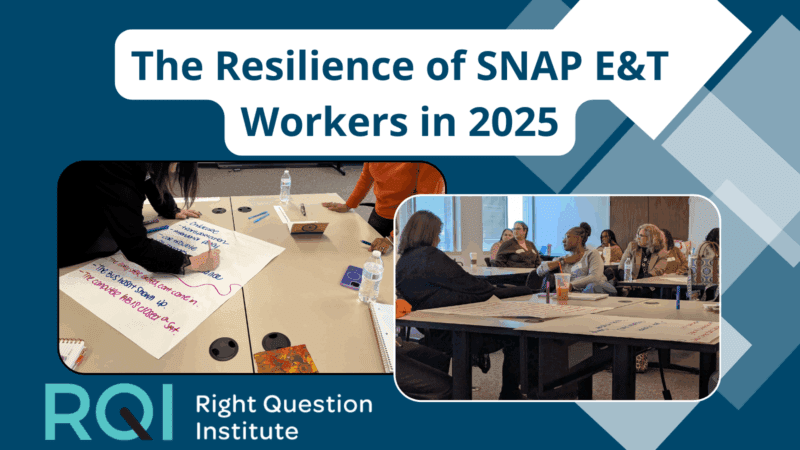
Over the past few months, RQI has been working with state SNAP Employment and Training (E&T) programs to train case managers in using the Right Question Strategy with SNAP recipients. This work has coincided with a lengthy government shutdown, new regulations about SNAP participant eligibility, turmoil surrounding budgets, and many other uncertainties.
My name is Keila Perez, and I’m the program associate for RQI’s Empowerment Program. In this role I coordinate and work with frontline workers across the country who incorporate the Right Question Strategy into their work with clients. We look forward to sharing more stories about our work with SNAP E&T case managers, but as the year winds down, I want to share some reflections and observations about what is happening, where things are going, and the incredible dedication and work we’ve seen from case managers working under difficult circumstances.
What is SNAP Employment & Training?
The Supplemental Nutrition Assistance Program (SNAP) provides assistance for purchasing groceries to low-income individuals and families. The SNAP E&T program supports SNAP recipients by providing resources and skill-building opportunities for securing employment, including job training and workforce development. SNAP E&T programs include on-the-job training, licensing programs (such as home health aid or bookkeeping certification programs), and other workforce development initiatives. Case managers for this program work with SNAP E&T participants to guide them through training programs and job-seeking efforts.
Building skills for asking questions
By using the Right Question Strategy, case managers help SNAP E&T participants build skills for asking questions to gather information, navigate the job training landscape, and advocate for themselves when decisions are being made that affect them.
SNAP E&T participants can use these skills for job interviews, financial planning, and choosing a training program. Securing employment and charting a path toward financial stability are goals that can be daunting and fear-inducing, but having tools to navigate new situations and overcome obstacles can make a difference. After using the Right Question Strategy, one SNAP E&T participant said, “This tool allows me to get past my stress [and] come up with an action plan.”
The resilience and adaptability of case managers
Our training with SNAP E&T case managers impressed on the RQI team that the work being done on the front lines of public systems requires profound resilience and adaptability. Public benefits administration is constantly shifting and requires case managers to be prepared to change the way they work in an instant. But this uncertainty does not stop them from continuing to assist their clients and ensure that vital public systems continue to support our communities. As one case manager put it, “As with any other changes, you learn how to work through them.”
2025 has been a particularly challenging year
In a public benefits landscape that is already teeming with uncertainty, case managers for SNAP E&T have faced enormous challenges in 2025.
Legislation that was passed mid-year made significant changes to SNAP eligibility, leaving direct service providers who administer public benefits responding quickly to connect (now ineligible) clients with resources. The historic government shutdown in October and November, which lasted a record-breaking 43 days, led to SNAP benefits not being released on the first of the month in November. This left families without grocery budgets and struggling to afford food at the beginning of the holiday season.
The case managers we partner with have continued to demonstrate their dedication and determination in the face of these challenges.
Changes to SNAP eligibility
Newly instituted expansions to work requirements mean that veterans, seniors, and caretakers have to find employment or participate in an approved program to continue receiving their SNAP benefits. Previous exemptions — for people experiencing homelessness and former foster youth — have also been eliminated. These work requirements for continued SNAP eligibility can be fulfilled through participation in a SNAP E&T program. As a result, SNAP E&T programs expect to see a stark increase in demand for services, and case managers will be at the forefront of helping participants get the resources they need and navigate a complex web of services.
At the same time, an increase in demand means case managers will be serving more SNAP participants with the same limited resources. Many SNAP E&T programs also have limitations due to enrollment caps or the number of available positions for trainees. SNAP participants seeking support in building workforce skills and securing employment may even be turned away as a result of the increased demand and limited supply.
Many refugees and asylum seekers lost SNAP eligibility overnight
Certain immigrant groups have also been impacted by the 2025 legislation. Eligibility changes mean that many previously qualified immigrants, mostly refugees and asylum seekers, became categorically ineligible for SNAP benefits overnight. For immigrants navigating life in a new country, building their network and community, SNAP benefits ensured their most basic needs were being met while they worked on building their skills and support systems.
Case managers working with immigrant groups told us that the Right Question Strategy had potential to help shift the mindset of their clients, building problem-solving skills and feelings of self-efficacy in the face of rapidly changing circumstances. While case managers at these organizations can no longer provide SNAP E&T services to affected immigrants, the skills for asking questions and participating in decisions will continue to support client self-advocacy and empowerment as they navigate systems.
The government shutdown
In November, we saw how resilient case managers are when SNAP benefits were impacted as a result of the government shutdown. They strategized on how to help SNAP recipients access food, sought information from state administrators, and advocated for the needs of program participants in the face of a national crisis. Although the role of case managers does not require advocacy on behalf of their program participants, these frontline workers demonstrated their commitment to the communities they serve.
What’s next?
The outlook on funding for SNAP benefits and E&T programs, and the future of many programs administered by the USDA Food and Nutrition Service, are still unclear. At the federal level, a continuing resolution passed by Congress ensured that SNAP will be funded through January 2026, but uncertainty remains as a federal budget has not been passed.
Case managers continue to diligently serve SNAP E&T participants, connecting them with resources for building essential skills, finding employment, and charting a path toward financial independence. These skills will be essential as low-income Americans continue to face the changing availability and accessibility of SNAP benefits.
Thank you to the frontline workers
The frontline workers who deliver direct services across the country have continued to show up this year, even in the face of shifting legislation, unpredictable funding outlooks, and clients whose needs are as great as ever. Their dedication drives us as we share RQI’s strategy for empowerment, agency, and self-advocacy through our free resources and network. We know that these frontline workers have a great impact on the lives of the people they serve, and we thank them for the work they do to strengthen communities.