Session Resources
- Slide Deck
- Cultivating Technocuriosity: Building Custom GPTs for K-12 Social Studies
- ChatGPT conversation from the session
- Ways to learn more:
About the event:
Description
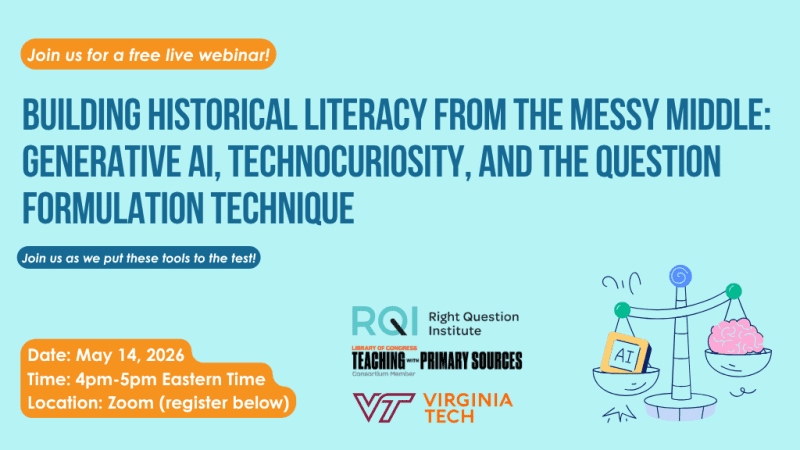
Can AI strengthen, rather than replace, students’ historical inquiry? Using LOC primary sources, we model the Question Formulation Technique (QFT) with ChatGPT acting as a “question coach,” providing real-time examples of the affordances (positive and negative) of generative AI. This work is through the lens of technocuriosity (a way of thinking and teaching using AI with nuance, remaining open to surprise, and resisting both hype and fear). In other words, come and watch us stress test Chatty Geeps! Technoskeptics welcome.
Speakers
 Amy Allen, Ph.D., is an Assistant Professor of History and Social Science Education in the Elementary Education program at Virginia Tech. Her research examines how teachers and students navigate history, technology, and inquiry in the age of GenAI. She explores how digital tools can support (not replace) the messy, human work of meaning-making. Her scholarship appears in Theory & Research in Social Education, The Social Studies, and Social Studies and the Young Learner, and she frequently presents at NCSS, NCHE, and AERA. Outside of work, Amy maintains a deeply analog relationship with karaoke, trivia, and chaotic good energy. When she’s not researching technocuriosity, she’s testing the limits of “place-based learning” at Disney parks, listening to Taylor Swift, and pretending she’s in a musical number nobody asked for but everyone secretly enjoys. She is deeply committed to serious scholarship but never taking herself too seriously.
 David Hicks, Ph.D., is a Professor of History and Social Science Education at Virginia Tech, where his research explores the integration of digital technologies and media to deepen historical inquiry and disciplinary thinking. With more than ninety publications, he has contributed significantly to understanding how technology can scaffold the analysis of historical sources, foster critical literacy, and humanize digital learning environments. Dr. Hicks’s scholarship combines historical rigor, technological innovation, and a commitment to helping teachers navigate the promises and perils of AI in history education. Outside of academia, David remains tragically unrecognized by the Academy, the Recording Industry, and, most cruelly, Mardi Gras king cakes. A self-proclaimed “Gen AI curious” historian, he divides his time between mentoring pre-service teachers, perfecting small animal puppetry, contemplating why Twitter’s rebrand destroyed civilization, and surfing TikTok. When not philosophizing about cognitive engineering, David dreams of a One Direction reunion and still insists Blur is better than Oasis.