The Right Question Institute contributes to thought leadership and research in fields such as student-centered learning, inquiry and curiosity, educational reform, school-family partnerships, health care, social services, innovation, and democratic action. Here are our two books, plus a sampling of publications related to RQI’s work.
Books
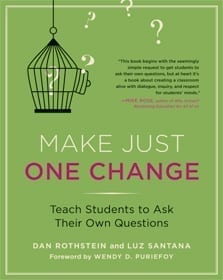
Make Just One Change: Teach Students to Ask Their Own Questions
It’s been translated into six languages, has been a top-selling pedagogical book in Japan, and remains one of Harvard Education Press’s all-time best sellers. Make Just One Change: Teach Students to Ask Their Own Questions introduced the world of education to the Question Formulation Technique, which has now spread to more than a million classrooms in over 160 countries.
By Dan Rothstein and Luz Santana, January 1, 2011, Harvard Education Press.
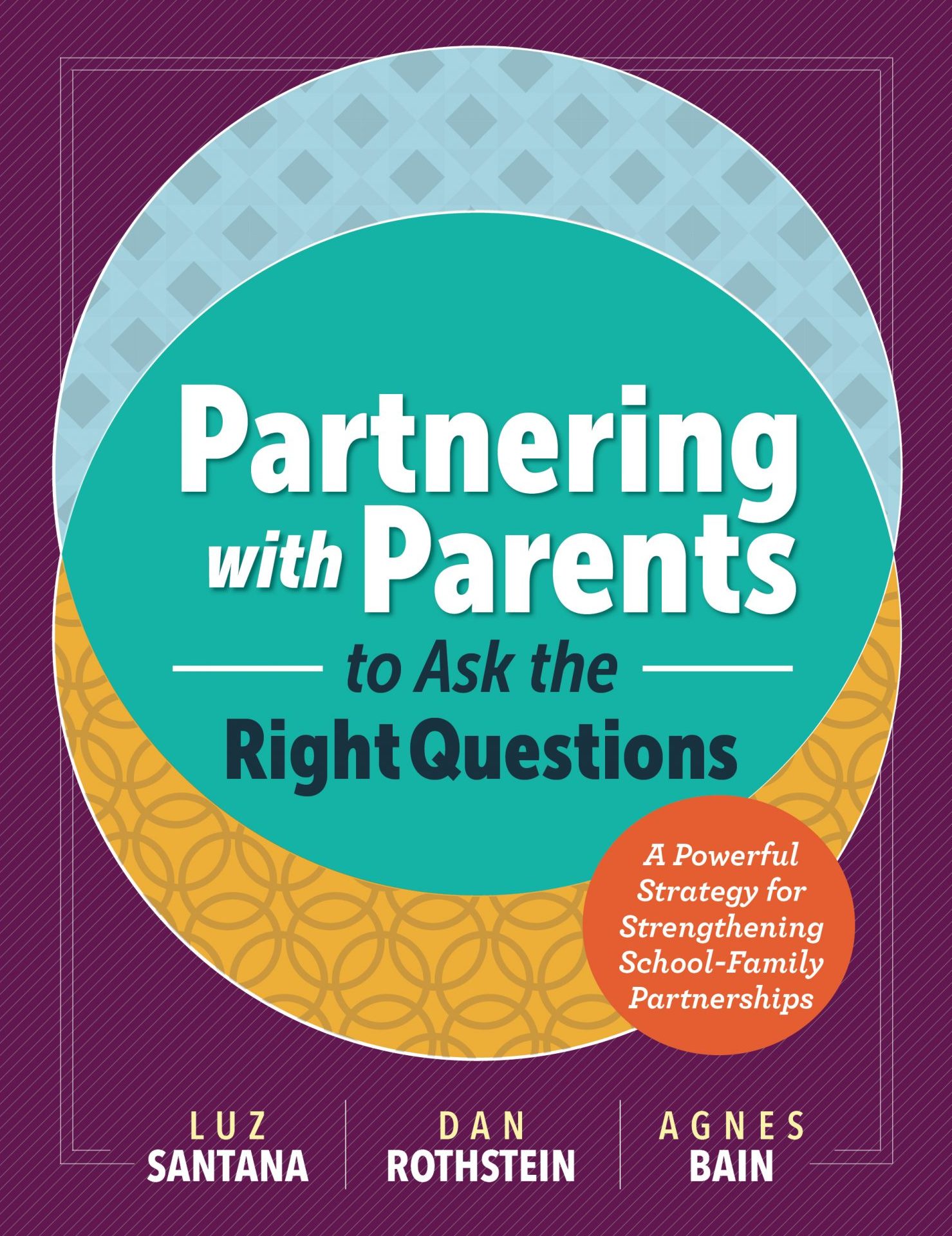
Partnering with Parents to Ask the Right Questions
Partnering with Parents to Ask the Right Questions maps a refreshingly simple approach to parent engagement — one that revitalizes communication, trust, and partnership between schools and families through parents’ questions. Educators learn a strategy to work with parents so they can better support, monitor, and advocate for children and schools.
By Luz Santana, Dan Rothstein and Agnes Bain, January 1, 2018, ASCD.
Featured Publications
Teaching Students to Ask Their Own Questions
Students “take greater ownership of their learning, deepen comprehension, and make new connections and discoveries on their own” through asking questions.
By Dan Rothstein and Luz Santana, September 1, 2011, Harvard Education Letter.

A Pathway Out of Poverty for Students in Low-Income Communities: Learning to Ask Questions
“If we believe there is a connection between academic success and ending poverty then we should invest in the potential of all students to learn to ask their own questions and to think for themselves.”
By Luz Santana, May 21, 2015, Harvard Education Press.
From Service Delivery to Capacity-Building: a Scalable Approach to Legal Empowerment
This case study highlights the experience of a legal services social worker and her clients using a method for legal empowerment. It explores a simple way to integrate capacity-building into practice.
By Naomi Campbell, December 6, 2021, Social Innovations Journal.
More Publications
Legal Empowerment
Microdemocracy and Systems Change: Q&A with the Right Question Institute
June 28, 2023, Wellbeing Blueprint.

Building Self-Advocacy Skills of Legal Services Clients: Three Principles for Promoting an Innovation in Practice
By Naomi Campbell & Luz Santana, March 4, 2021, Social Innovations Journal.
Education
Sparking Joy in the Classroom with Student-Formulated Questions
By Sarah Westbrook, Andrew Minigan & Chris Orchard, March 20, 2019, Teaching Channel.

How ‘Just One Change’ in the Classroom can Lead to Greater Student Curiosity
By Andrew P. Minigan, September 7, 2018, PBS Teachers' Lounge.
Using the Question Formulation Technique to Guide Primary Source Learning
By Ashley Melville & Andrew P. Minigan, April 24, 2018, EBSCO.
Response: Instructional Strategies Teachers Might Be Missing
By Dan Rothstein, David Jacob & Greg Brown, January 30, 2018, Education Week.
“Asking Questions in the Age of Google” Post-Webinar Q&A
By Connie Williams & Andrew P. Minigan, January 29, 2018, EBSCO.
Facilitating Student Curiosity: Strategies and Resources
By Andrew P. Minigan, January 25, 2018, Education Week.
Inquiring Minds: Using the Question Formulation Technique to Activate Student Curiosity
By Andrew P. Minigan & Joshua Beer, December 1, 2017, The New England Journal of History.
Response: Ways to Use Questions Effectively in the Classroom
By Dan Rothstein, November 18, 2017, Education Week.
Stimulating and Sustaining Inquiry with Students' Questions
It is crucial that students in the twenty-first century learn how to formulate and use questions, drive their own inquiries, and apply question formulation skills in their everyday lives.
By Andrew P. Minigan, Sarah Westbrook, Dan Rothstein, and Luz Santana, October 1, 2017, Social Education.
How Questioning Can Drive Arguments, Productive Debate & Information Literacy Among Students
By Sarah Westbrook, June 16, 2017, EBSCO.
The Importance of Curiosity and Questions in 21st-Century Learning
By Andrew P. Minigan, May 24, 2017, Education Week.

Creating Equitable and Curiosity-Filled Classrooms through Students’ Questions
By Andrew P. Minigan, April 18, 2017, Center for Collaborative Education.
Response: Dos & Don’ts of Implementing New Ideas in Education
By Dan Rothstein, March 25, 2017, Education Week.
Build STEM Skills and Nurture Students’ Scientific Curiosity With the Question Formulation Technique
By Andrew P. Minigan, February 22, 2017, EBSCO.
Education Week Spotlight on Inquiry-Based Teaching and Learning
By Andrew P. Minigan, January 1, 2017, Education Week.
Cultivating Curiosity by Deliberately Teaching Students How to Ask Questions
By Andrew P. Minigan, October 7, 2016, Education Week.
Response: Metacognition Is a 'Catalyst for Action'
By Dan Rothstein, October 3, 2016, Education Week.
Questions, Frameworks, and Classrooms
By John Lee, Kathy Swan, SG Grant, Dan Rothstein, & Luz Santana, September 1, 2015, C3 Teachers.
Making Questions Flow
By Dan Rothstein, Luz Santana, & Andrew P. Minigan, September 1, 2015, Educational Leadership.
The Right Questions
By Dan Rothstein & Luz Santana, October 1, 2014, Educational Leadership.

‘A Holy Curiosity’: We Can Vastly Improve Education by Teaching this One Skill
By Dan Rothstein, March 14, 2014, WBUR.

Sharing the Power of the Question
By Dan Rothstein & Luz Santana, March 29, 2012, ASCD Express.
Setting Off and Sustaining Sparks of Curiosity and Creativity
By Dan Rothstein, January 13, 2012, Voices in Education: The Blog of Harvard Education Publishing.
Learning to Ask Questions: A Pathway to and Through College for Students in Low-Income Communities
By Luz Santana, October 20, 2015, About Campus.
School-Family Partnership
Helping Parents Ask Good Questions
By Luz Santana, September 28, 2017, ASCD Express.
Social Services
Frontline Staff as Social Innovators
By Luz Santana & Dan Rothstein, February 1, 2010, Social Innovations Journal.
Health Care
Asking questions: The effect of a brief intervention in community health centers on patient activation
By Darwin Deen, Wei-Hsin Lu, Dan Rothstein, Luz Santana, & Marthe R. Gold, August 1, 2011, Patient Education and Counseling.
Activating Community Health Center Patients in Developing Question-Formulation Skills
By Wei-Hsin Lu, Darwin Deen, Dan Rothstein, Luz Santana, & Marthe R. Gold, May 10, 2011, Health Education & Behavior.
Evaluation of a Patient Activation and Empowerment Intervention in Mental Health Care
By Margarita Alegría, Antonio Polo, Shan Gao, Luz Santana, Dan Rothstein, Aida Jimenez, Mary Lyons Hunter, Frances Mendieta, Vanessa Oddo, & Sharon-Lise Normand, March 1, 2008, Medical Care.
Patient–Provider Communication: Understanding the Role of Patient Activation for Latinos in Mental Health Treatment
By Dharma E. Cortes, Norah Mulvaney-Day, Lisa Fortuna, Sarah Reinfeld, Margarita Alegría, April 15, 2008, Health Education & Behavior.
The impact of different modalities for activating patients in a community health center setting
By Darwin Deen, Wei Hsin Lu, Miranda Ritterman Weintraub, Michael J. Maranda, Suzanne Elshafey, Marthe R. Gold, October 1, 2012, Patient Education and Couseling.
Microdemocracy

Questions, Agency and Democracy
By Dan Rothstein, February 25, 2017, Medium.